
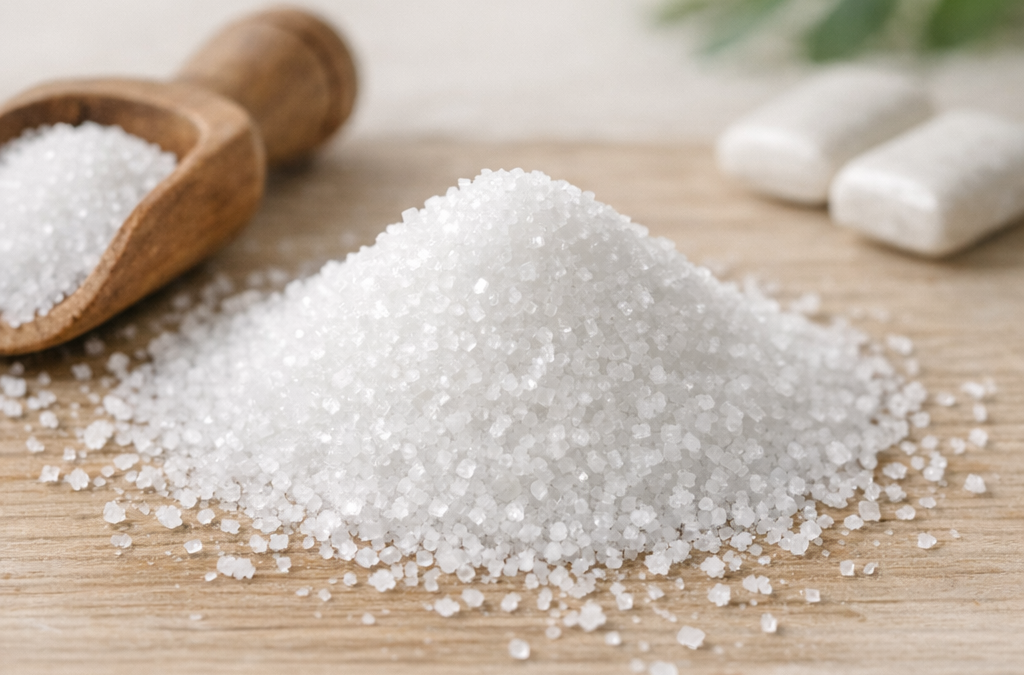
A Choice Grounded in Physiological Truth, Not Industry Trends.
Xylitol has become one of those ingredients people assume is universally “good” for oral health. It shows up in gums, mints, candies, and increasingly in toothpaste tablets. But when you look closely at how xylitol is made, how it behaves in the body, and how it actually works in real‑world brushing, the story becomes far more complicated.
Let’s break it down.
Commercial xylitol doesn’t come from fruit or birch trees in any meaningful way. It comes from lignocellulosic biomass — mostly corn cobs and sometimes hardwood scraps. To extract the precursor sugar (xylose), manufacturers must break apart tough plant fibers using acid hydrolysis, which produces a slurry containing xylose plus impurities like acetic acid, formic acid, furfural, and phenolic compounds. These must then be aggressively purified.
From there, xylitol is created through one of two industrial routes:
• Chemical hydrogenation — the dominant method — which requires nickel catalysts, temperatures up to 300°C, and hydrogen pressures up to 50 atmospheres. This step alone accounts for 95% of the global warming impact of xylitol production.
• Microbial fermentation, a newer alternative, still requires bioreactors, controlled aeration, and multi‑stage purification. It’s gentler but still far from “natural.”
Either way, the final product is a highly refined polyol — not a whole‑plant ingredient, not an Ayurvedic botanical, and not something that fits Rootfresh’s radical simplicity standard.
2. As a Sweetener, Xylitol Isn’t the Upgrade People Think It Is
Xylitol is often marketed as a “better sugar,” but the data paints a more nuanced picture.
• It has a glycemic index of 7–13, which is low — but low GI alone doesn’t make a sweetener healthy. Research shows that sugar alcohols like xylitol are associated with higher rates of heart disease in heavy consumers.
• It commonly causes gas, bloating, and digestive discomfort, because sugar alcohols ferment in the gut. Many people simply don’t tolerate it well.
Compare that to monk fruit — the sweetener Rootfresh uses — which has zero glycemic impact, is botanical, and doesn’t carry the same GI or digestive concerns.
Xylitol isn’t “bad,” but it’s not the clean, superior sweetener people imagine.
3. The Most Important Point: Xylitol’s Oral Benefits Require Large Doses and Long Contact Time — Not Toothpaste‑Level Exposure
This is the part almost no toothpaste brand talks about.
The clinical evidence supporting xylitol’s dental benefits is real — but only under very specific conditions:
This is not how toothpaste works.
Toothpaste contains tiny amounts of xylitol, and brushing provides maybe, 2 minutes of contact, followed by rinsing. That’s nowhere near the exposure required to meaningfully reduce Streptococcus mutans or influence caries outcomes.
Even the meta‑analysis showing xylitol’s benefits emphasizes that the effective products were 100% xylitol gums and lozenges, not toothpaste.
4. Xylitol’s Mechanism Doesn’t Align With Rootfresh’s Microbiome Philosophy
Rootfresh’s approach is different:
5. So Why Doesn’t Rootfresh Use Xylitol?
Because when you combine the science with our philosophy, the answer becomes clear:
Rootfresh is built on clarity, not shortcuts — and xylitol simply doesn’t meet the bar.